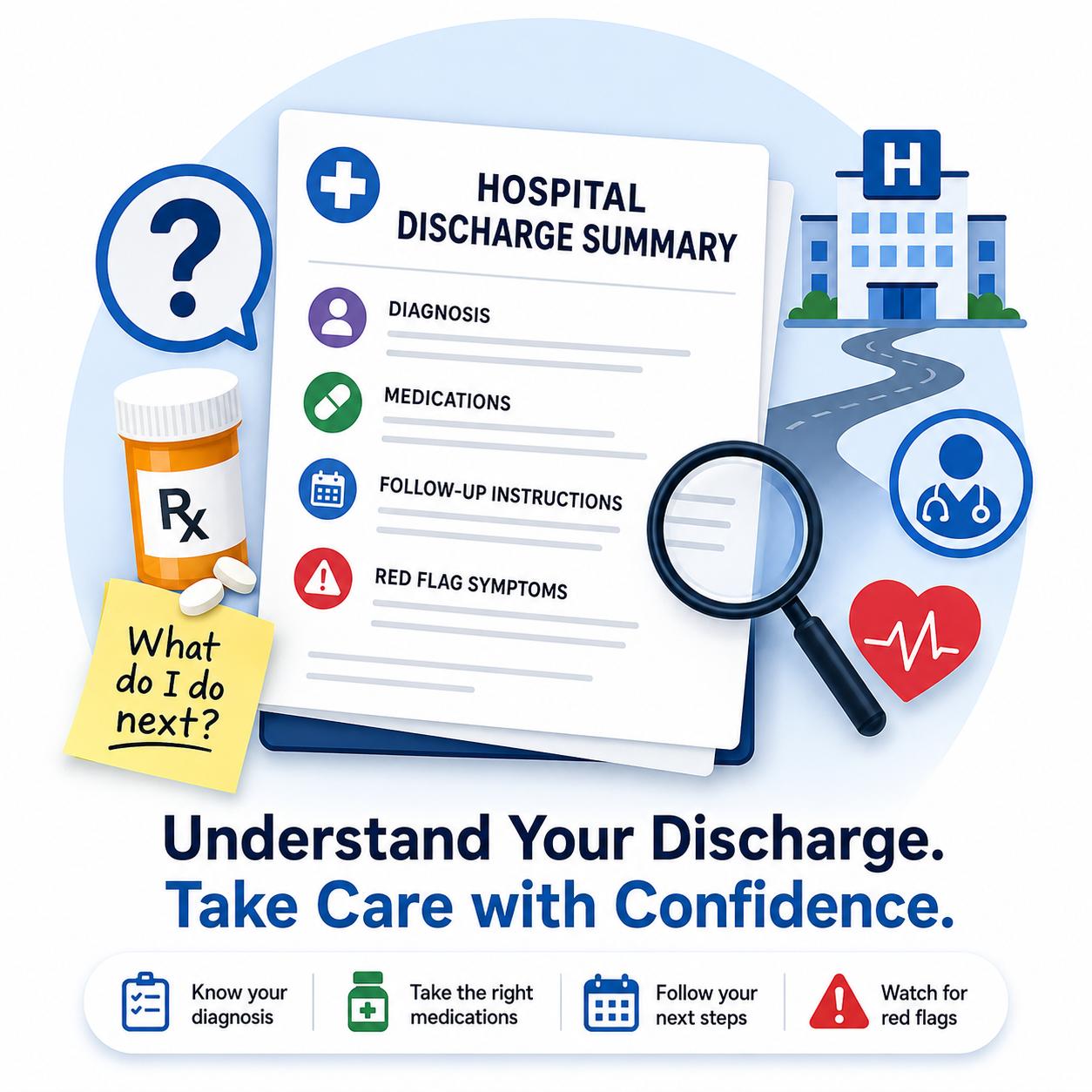
You or someone you love just got home from the hospital. You are tired, relieved, maybe a little scared — and then someone hands you a stack of papers called a **discharge summary**. It is full of medical terms, abbreviations, and instructions that can feel overwhelming. You should not need medical school to understand your next steps. This guide walks through a typical discharge summary section by section, so you know what you are reading and what to do about it. ## What is usually in a discharge summary? Most discharge summaries follow a similar structure: 1. **Primary diagnosis** — The main reason for admission.2. **Procedures performed** — Surgeries, tests, or interventions during the stay.3. **Medications** — What was given in the hospital and what to continue at home.4. **Follow-up instructions** — Appointments, restrictions, and recovery steps.5. **Red flag symptoms** — Warning signs that require urgent care or ER return. ## Common terms decoded - **PRN** — “As needed”- **BID / TID / QID** — Twice daily / Three times daily / Four times daily- **NPO** — Nothing by mouth- **SOB** — Shortness of breath- **Hx** — History- **Dx** — Diagnosis- **Rx** — Prescription or treatment- **CBC** — Complete blood count- **BP / HR** — Blood pressure / Heart rate ## The first 48 hours: your practical checklist Most readmissions happen when discharge instructions are misunderstood or delayed. Use this checklist: - ✅ Fill all new prescriptions the same day.- ✅ Call your primary care doctor to schedule follow-up.- ✅ Read and share the red-flag section with a family member.- ✅ Confirm your medication schedule (set phone reminders if needed).- ✅ If anything is unclear, upload your summary to NeuroMed Aira for plain-language guidance. ## Final reminder Discharge papers should not feel like a mystery. NeuroMed Aira can read your discharge summary and explain it in simple language for you, your parent, or a family member who prefers Spanish, Tagalog, or another language. 👉 Try it free at [neuromedai.org](https://neuromedai.org) — no credit card, no jargon. Neuroscience Diagnostics Patient care Research