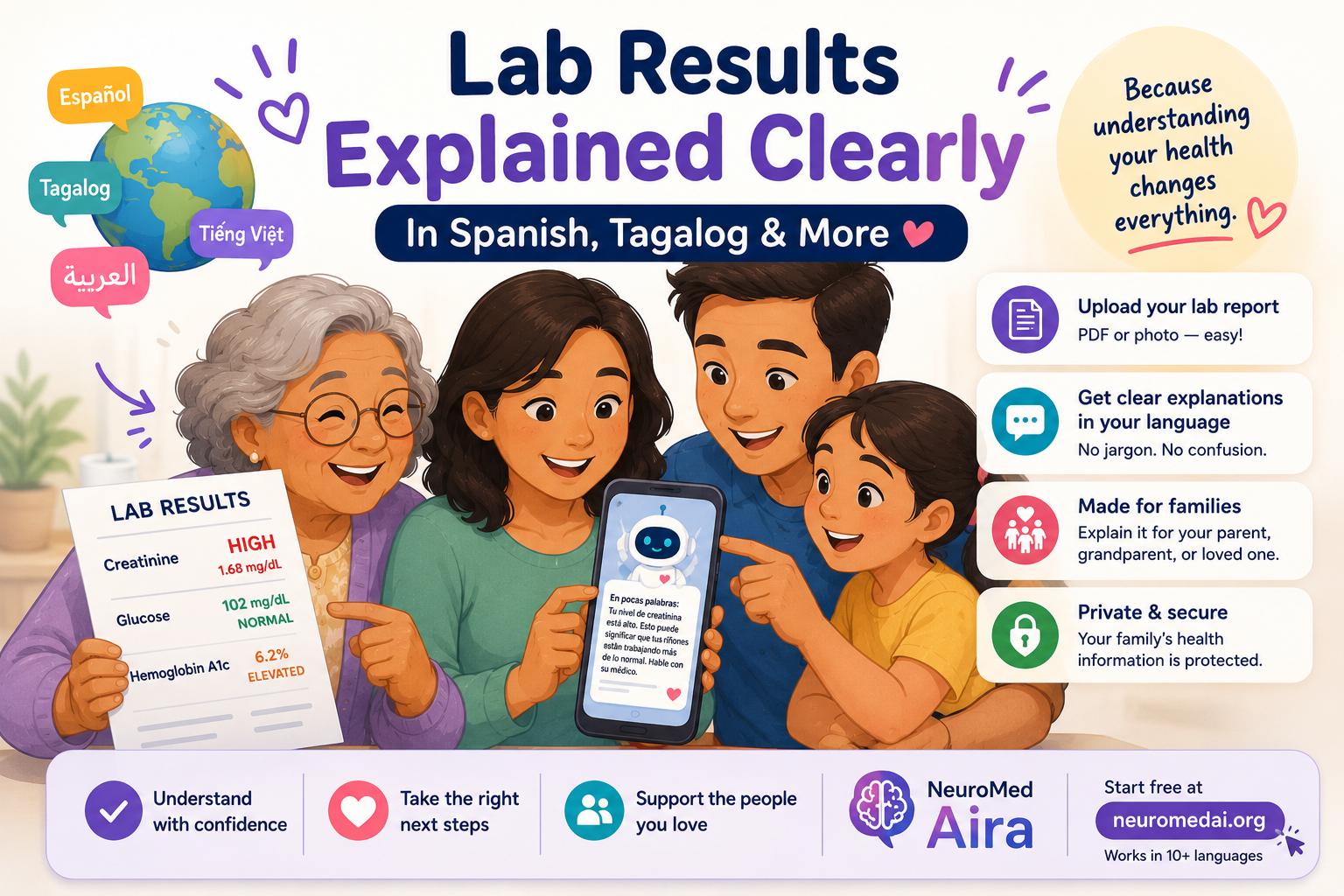
When a loved one’s lab results come in English and they only speak Spanish or Tagalog, the confusion can be frightening. Your abuela gets bloodwork results. The doctor speaks quickly, the paper is full of abbreviations, and everyone at home is trying to translate in real time. This is common in multilingual families — and it is one of the most preventable causes of missed follow-up care. ## Why language barriers in healthcare are serious Patients with limited English proficiency are more likely to misunderstand diagnoses, delay follow-up, and experience worse outcomes. That is not because families do not care. It is because healthcare systems are often not built for multilingual communication. In many immigrant households, younger family members become informal interpreters in emotionally intense moments they were never trained for. ## What “explained in Spanish” should really mean Medical language support is more than literal translation. It needs: - **Context** — explaining what a result means, not just translating the word- **Tone** — reducing panic while staying accurate- **Cultural sensitivity** — respecting family-centered decision making- **Safety and precision** — preventing dangerous misunderstandings ## How NeuroMed Aira helps multilingual families NeuroMed Aira is designed for families navigating healthcare across languages: - 🌐 Full conversation in your language (Spanish, Tagalog, French, Arabic, Vietnamese, Korean, and more)- 📄 Upload PDFs or photos of lab reports for plain-language summaries- ❤️ Family-aware explanations (for elderly parents or loved ones)- 🔒 Privacy-first protection for sensitive health data ## Your family deserves clarity Whether you are helping your lola in Tagalog, your abuela in Spanish, or any loved one in another language, clear understanding should not be a luxury. Upload the report, choose a language, and ask your questions naturally. 👉 Start free at [neuromedai.org](https://neuromedai.org) — works in 10+ languages. Neuroscience Diagnostics Patient care Research